TBW / ENTERPRISE KNOWLEDGE AI
Enterprise RAG & Knowledge AI
Turn trusted enterprise knowledge into secure, grounded AI answers.
Build AI assistants that retrieve approved information, respect user permissions, cite sources and connect to enterprise applications.
Book a RAG & Knowledge AI ConsultationExplore the Architecture
Grounded answers · Source citations · Permission-aware retrieval · Hybrid search · Enterprise security · Private deployment options
What Enterprise RAG Can Do for Your Business
Find knowledge faster
Search approved policies, procedures and documentation in natural language.
Ground answers in sources
Supply relevant approved context and reduce unsupported answers without promising perfection.
Respect user permissions
Filter retrieved content against the authenticated user’s access before model input.
Show sources
Return citations so important answers can be checked.
Keep knowledge current
Track changes, removals and permission updates in source systems.
Integrate enterprise systems
Connect supported document, ticketing, wiki, CRM and API sources.
Support private architectures
Choose supported cloud, private, hybrid or self-hosted components per requirements.
Enterprise RAG Use Cases
Internal knowledge assistant
Authorized employees search corporate documents with citations.
IT and service desk
Ground answers in approved runbooks, KB articles and incident guidance.
Policies and procedures
Find current controlled guidance without bypassing document permissions.
Technical documentation
Locate version-specific engineering and operations information.
Compliance knowledge
Retrieve approved control material for human review, not automated legal determinations.
Customer support knowledge
Ground support in approved product and service documentation.
Sales and product knowledge
Search current enablement content for authorized teams.
Research and discovery
Synthesize controlled collections while preserving source access boundaries.
Why RAG Fails in Production
Stale or conflicting sources
Answers drawn from outdated documents.
Missed documents
The right content exists but retrieval doesn’t find it.
Wrong ranking
Topically similar passages beat the one that actually answers.
Leaked data
Users get answers built from documents they should not see.
Most RAG problems start in retrieval, permissions and data quality, not in the model.
How Enterprise RAG Works
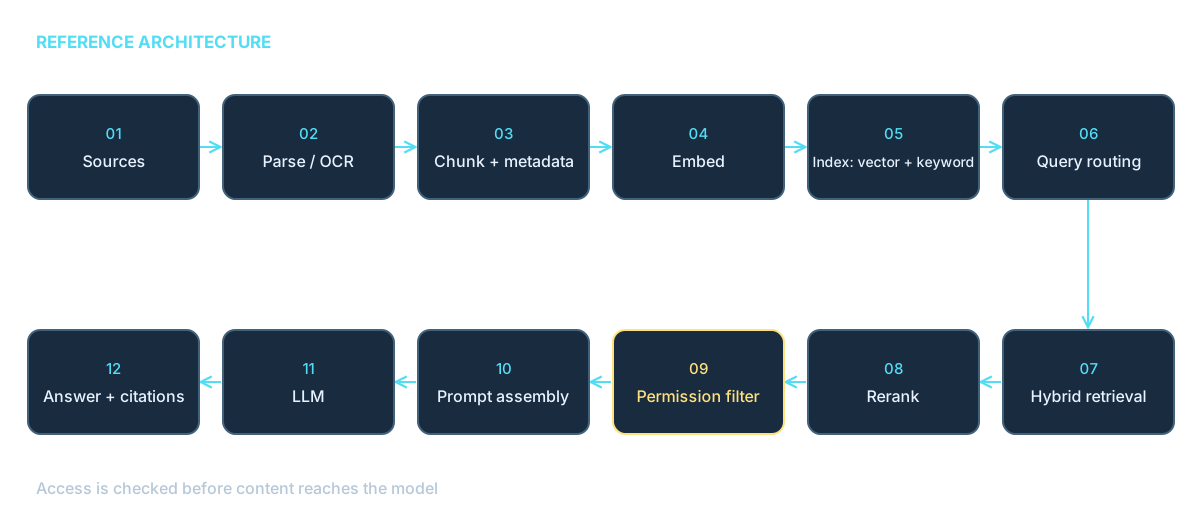
Sources are parsed and indexed, candidates are retrieved, permissions are checked before context reaches the model, and supported answers cite their sources. Identity, classification, encryption, logging, freshness, evaluation and governance apply across the flow.
View Detailed 12-Stage RAG Architecture Discuss Your RAG Architecture
Permission-Aware Retrieval
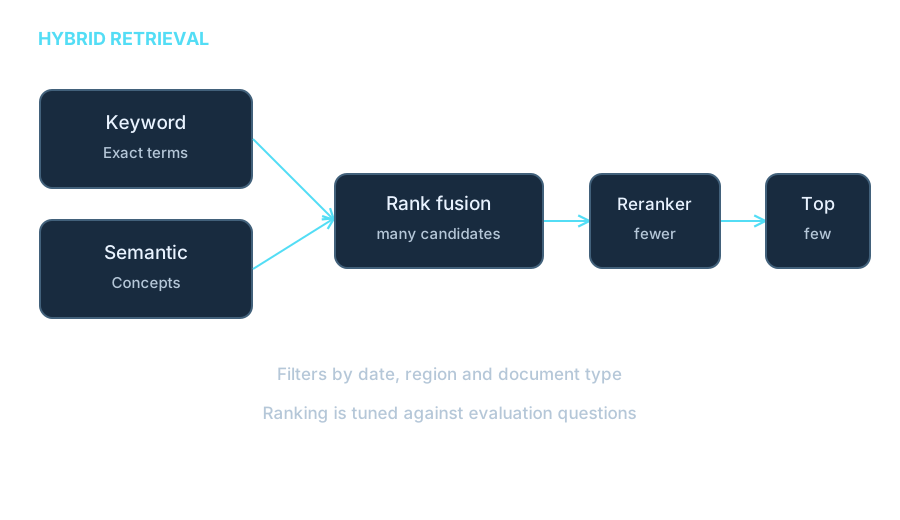
A production RAG system must not retrieve everything and ask the model to decide who may see it. Authenticate the user, map relevant groups, roles, attributes and tenant, then enforce source/document authorization before any sensitive passage enters model context. ACL propagation depends on the source system, connector, APIs and architecture.
Identity
Map the caller to verified user and service identities.
Authorization filter
Apply document, group, role, classification and tenant entitlements.
Approved context
Pass only permitted retrieved passages to generation, with source provenance.
Secure RAG by Design
Controls must be designed and tested for each environment; no single measure eliminates prompt injection, leakage or hallucinations.
Identity and authorization
Authenticate users and services; enforce access before model input.
Data protection
Use encryption, minimization, retention and redaction appropriate to the data.
Prompt injection
Treat user text and retrieved content as untrusted; constrain tools and validate outputs.
Document poisoning
Track source trust, ownership, changes and ingestion provenance.
Tenant isolation
Test boundaries between organizations and business units.
Audit and oversight
Log permitted retrieval and tool events; require human review for consequential use.
How We Evaluate RAG Quality
Targets come from representative questions and the customer’s risk profile. Any dashboard on this page is illustrative, not a TBW production benchmark.
Retrieval quality
Context precision and recall, ranking, hit rates and query-class coverage.
Answer quality
Faithfulness, relevance, citation support and unsupported claims.
Security and authorization
ACL enforcement, tenant isolation, injection and sensitive-data leakage tests.
Operational quality
Latency, ingestion errors, freshness, availability and cost.
Connect Enterprise Knowledge Sources
Documents and files
SharePoint, OneDrive, Google Drive, file shares, Office, PDF and object storage where supported.
Knowledge and collaboration
Wikis, Confluence, support articles and internal documentation.
Business systems
Ticketing, CRM, ServiceNow, Salesforce and ERP APIs where applicable.
Databases and APIs
Structured data, SQL, internal services and approved application APIs.
Web and content
Controlled websites, portals, CMS and documentation platforms.
Connector availability and permission preservation depend on source APIs, licensing, architecture and security requirements.
Knowledge Freshness & Provenance
Production RAG is not a one-time indexing task. Maintain source ownership, version history, permissions, deletion handling and monitoring throughout the knowledge lifecycle.
Keep the index current
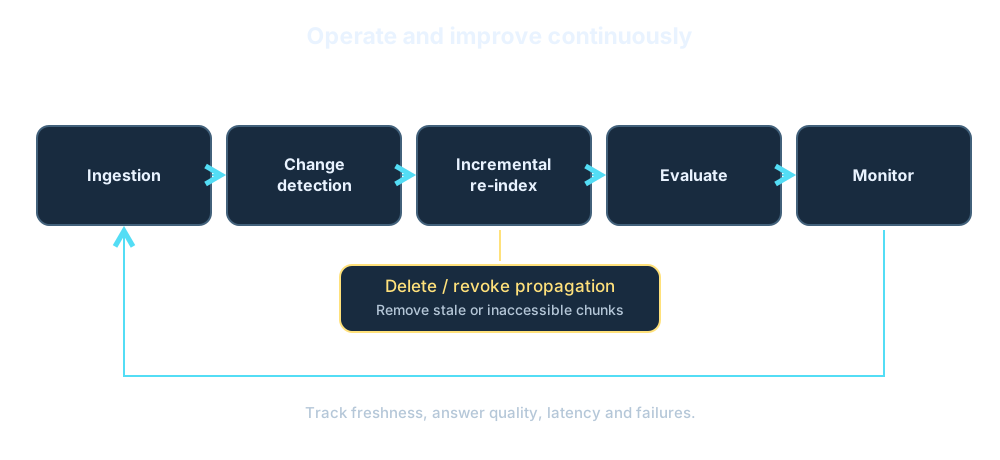
Detect source changes, synchronize or reprocess content, update embeddings and indexes where needed, validate ingestion, and alert on failures. Deleted or revoked material should be removed from retrieval or made inaccessible promptly according to the architecture.
Track document provenance
Retain the source system and identifier, owner, classification, version, modification and ingestion times, status, and relevant permission metadata where available. These records support citations, freshness checks, audits and investigations.
Lifecycle: Source change → Detect → Reprocess → Re-index → Validate. Source removal or permission revocation → remove or revoke retrievable access.
RAG Deployment Options
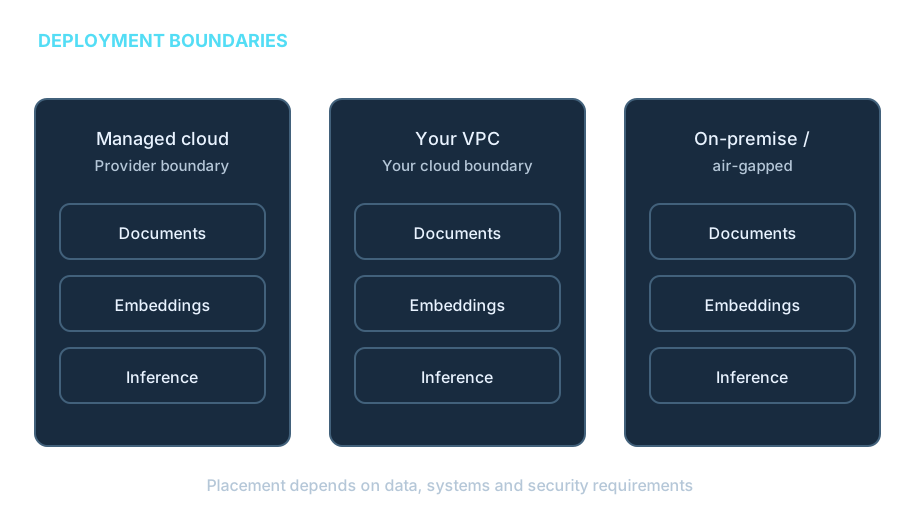
Managed cloud
Provider-managed operations can reduce your operational load; data-location controls and ongoing fees require review.
Your VPC or private cloud
Keep components in your cloud boundary with more operational control; your team takes on more maintenance and cloud cost.
On-premise or air-gapped
Keep components on local infrastructure for strict isolation; hardware, upgrades and staffing increase operational effort.
Components such as self-hosted vector databases, embedding servers and open-weight models can run inside your boundary when requirements demand it. See private AI, local AI and AI infrastructure.
TBW RAG Services
Service catalogue
RAG Readiness Assessment
What it is: source inventory, data-quality review, permission mapping and use-case ranking. What you get: findings report, architecture recommendation and roadmap. For teams deciding whether and where to start.
Proof of Concept
What it is: one knowledge domain, hybrid retrieval, citations and baseline evaluation using real questions. What you get: working prototype, evaluation results and go/no-go recommendation. For teams testing feasibility.
Production Build
What it is: connectors, ingestion, retrieval tuning, access controls, observability, evaluation pipeline and deployment. What you get: a running system, runbooks and test set. For teams moving a validated case into operation.
Secure RAG Review
What it is: permission-leak, indirect prompt-injection and document-poisoning tests plus access-control review. What you get: findings with prioritized fixes. For teams with an existing RAG system.
Managed Operations
What it is: re-indexing health, quality and drift monitoring, periodic review and tuning. What you get: a monthly report and improvement backlog. For teams seeking optional ongoing support.
Training and Handover
What it is: workshops for engineers and content owners. What you get: documentation and an evaluation playbook. For teams taking ownership of the system.
How TBW Delivers Enterprise RAG
Actual timing depends on source systems, data quality, integrations, security and organizational readiness.
Discover
Bound use cases, users, questions and risk.
Assess knowledge
Inventory sources, owners, formats, permissions and freshness.
Design
Specify ingestion, retrieval, authorization and evaluation.
Build
Implement approved pipelines, interfaces and citations.
Evaluate
Test retrieval, answers, permissions, security and latency.
Secure
Validate ACLs, tenant boundaries, injection controls and logs.
Pilot
Release to controlled users against agreed success criteria.
Operate
Monitor freshness, quality, cost, feedback and incidents.
Example: Secure Internal Knowledge Assistant
Illustrative question: “Which remote-access policy applies to contractors?”
The system authenticates the user, checks group membership, searches approved policy sources, filters inaccessible passages, reranks candidates and returns a cited answer—or says when evidence is insufficient. Permitted retrieval metadata may be logged for review.
Flow: User → Identity → Retrieval → Authorization → Rerank → AI → Cited Answer
Detailed 12-Stage RAG Architecture
Follow the directed path below. Select a stage in the original interactive architecture for its design decisions.
Select a stage to explore the decisions behind it. Use arrow keys to move between stages.
What TBW decides at each stage
- Sources: Choose approved repositories, owners and update rules; trace every answer to a source.
- Parse / OCR: Decide how scanned pages, tables and file formats are extracted and checked.
- Chunk + metadata: Chunk size and overlap by document type; attach owner, classification, ACL, source and update date to every chunk.
- Embed: Select embeddings for the language, domain and deployment boundary; test changes against real questions.
- Index (vector + keyword): Combine semantic and exact-term search, with update and deletion paths.
- Query routing: Send questions to the appropriate index or structured-data tool based on intent.
- Hybrid retrieval: Blend keyword and semantic candidates, then apply metadata constraints.
- Rerank: A second-stage model re-orders candidates by how well they answer the question. It improves precision but adds latency, so we tune it per use case.
- Permission filter: The user’s identity filters results before the prompt is built. Access control is enforced in the data layer, not in the prompt.
- Prompt assembly: Provide only permitted context, with source references and bounded instructions.
- LLM: Choose a model and hosting boundary appropriate to the use case; test its answers before production.
- Answer + citations: Return an answer with traceable citations, or say when evidence is insufficient.
 Open full-size diagram
Hybrid Retrieval & Architecture Choices
Retrieval design should follow the questions, data, permissions and operating requirements—not a default vector database choice.
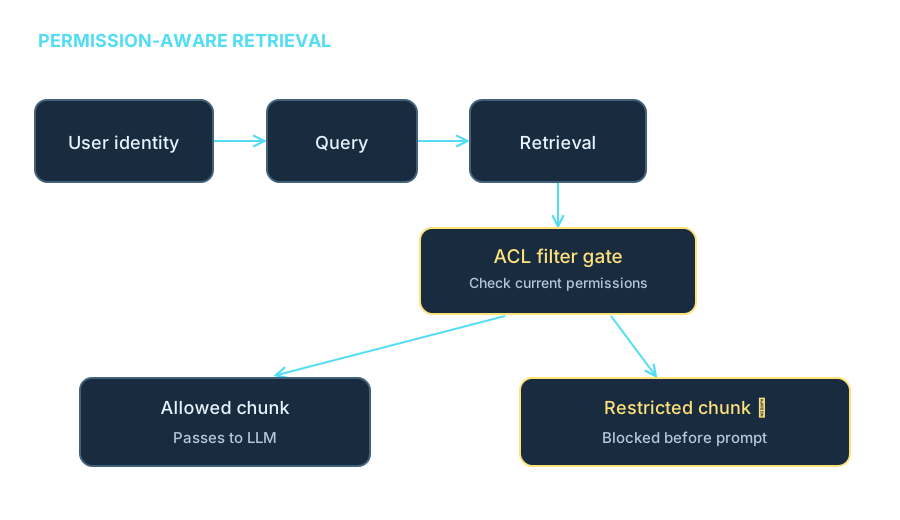
Hybrid retrieval and reranking
Semantic retrieval finds conceptually similar passages. Lexical search such as BM25 remains useful for product codes, error messages, commands, names and exact phrases. Combine candidates using rank fusion where appropriate, apply metadata and authorization filters, then rerank authorized candidates before model context is assembled.
RAG, long context or fine-tuning?
RAG suits changing knowledge that needs citations and permission-aware access. Long context may simplify a small bounded document set, but cost, latency and access boundaries still matter. Fine-tuning primarily changes model behavior or task performance, not the default mechanism for frequently updated knowledge. These approaches can work together.
Storage and chunking fit the workload
Choose chunking through evaluation of document structure, semantics and real queries; there is no universal best size. PostgreSQL with pgvector can fit a workload already using PostgreSQL. Compare any vector-search option against filtering, latency, updates, availability, scale, operations and cost—not corpus size alone.
RAG Technical Details
The engineering and security explanations below retain the original technical depth. Open a topic to explore it.
Retrieval engineering
Retrieval engineering
Hybrid retrieval joins keyword and semantic search because enterprise content contains both exact terms and concepts. Metadata filters can narrow results by date, region and document type.
Cross-encoder reranking can improve relevance but adds latency. Query routing directs structured or multi-hop questions to the right tool: a vector index, SQL or a knowledge graph. GraphRAG belongs only where relationship questions justify it.
Connecting to existing sources also calls for deliberate enterprise integration.
Original security by design
Security by design
Store access-control metadata with every chunk and enforce permissions at retrieval time, since permissions can change after ingestion. Treat the LLM as untrusted for access decisions. Design for audit logging, PII redaction and tenant isolation according to your environment.
Test indirect prompt injection and document poisoning. RAG does not remove prompt injection; retrieved text shares the model’s context window, so it is tested.
Explore our AI security and governance approach.
Original measured quality
Measured quality
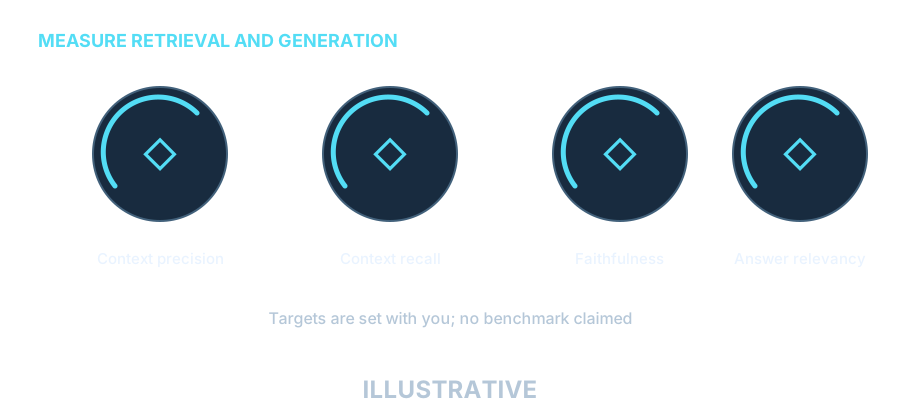
Retrieval and generation are measured separately: context precision, context recall, faithfulness and answer relevancy.
We build a test set from real questions, set target thresholds with you, and re-run it after every change. Results depend on your data and use case; the dashboard is illustrative, not a benchmark.
RAG explained
Knowledge: understand the choices
RAG explained in 60 seconds
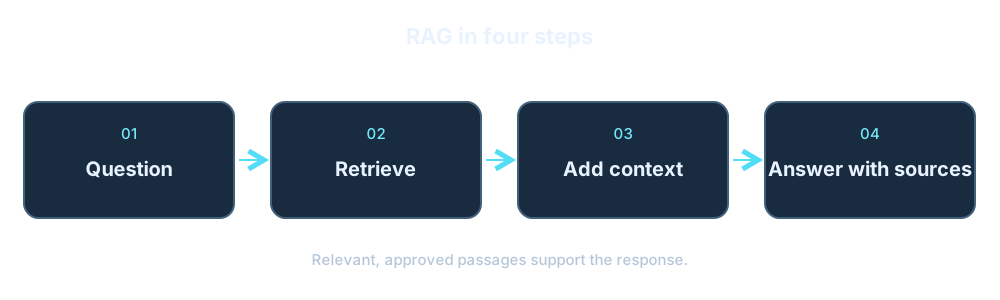
Retrieval-augmented generation (RAG) finds relevant information before an AI model answers a question. The retrieved passages provide context, and the answer can link back to their sources.
That does not make every answer correct: the source material, retrieval and permission checks still need testing. Think of it as a way to consult approved knowledge, not to teach a model permanent facts.
RAG versus fine-tuning and long context
RAG vs fine-tuning vs long context
| Approach | Best for | Weak at | Choose it when |
|---|---|---|---|
| RAG | Fresh, large or private knowledge with citations | Needs good data and retrieval tuning | Knowledge changes often, exceeds one prompt, or sources must be shown |
| Fine-tuning | Consistent tone, format and domain behavior | Does not keep facts current or show their origin | The model has the facts but responds in the wrong style or structure |
| Long context | Small, stable document sets and whole-document reasoning | Cost and latency grow with size; middle-of-prompt details may be missed | The full set fits in the prompt and questions are exploratory |
| Combined | Retrieval selects; long context reasons; fine-tuning shapes behavior | More components to operate | The use case genuinely requires all three |
Not every knowledge problem needs RAG. If your content is small and stable, we will tell you. Rule of thumb: knowledge gaps point to RAG; behavior gaps point to fine-tuning.
Chunking and parent-child retrieval
Chunking guide
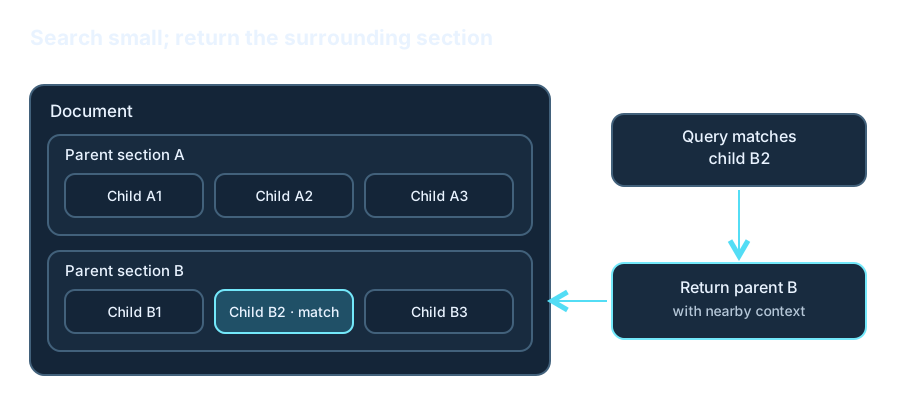
Chunking strategy should be selected and evaluated against document structure, semantics, query patterns, retrieval quality, model behavior and business requirements. Recursive splits around 300–512 tokens with 10–20% overlap can be a starting point for experimentation, not a universal requirement. Semantic chunking can help long, multi-topic prose, at higher ingestion cost.
Parent-child chunking searches small passages and returns a larger surrounding section, useful for contracts and technical documentation. Page- or structure-aware chunking preserves meaning in PDFs, tables and manuals.
Match the strategy to the content; there is no universal best chunk size.
Retrieval toolbox
Retrieval toolbox
Hybrid search
Combine exact keyword matches with semantic similarity when content includes both identifiers and concepts.
Rank fusion
Merge ranked lists from different retrievers when their scoring scales cannot be compared directly.
Metadata filtering
Limit candidates by attributes such as date, region, classification or document type before answers are built.
Reranking
Reorder candidate passages against a question when first-pass search needs better precision; budget for latency.
Query rewriting and routing
Clarify a question or choose SQL, search or another tool when one index cannot answer every query.
GraphRAG
Explore explicit relationships for genuinely multi-hop questions; avoid the extra complexity otherwise.
Data readiness
Data readiness checklist
Planning prompts, not interactive form controls:
- Clear owner for each source
- Current versions identified
- Duplicates handled
- Access rules documented
- Sensitive data classified
- Formats inventoried: PDF, Office, wiki, tickets and email
- Update frequency known
- Representative success questions collected
RAG amplifies both good and bad data quality.
RAG & Knowledge AI Glossary
Glossary
RAG
Retrieval-augmented generation: retrieve relevant material and add it to the model’s context before answering.
Embedding
A numeric representation of content used to compare approximate meaning.
Vector database
An index for searching embeddings by similarity.
Chunk
A smaller passage of a source document prepared for search.
Hybrid search
A combination of keyword and semantic retrieval.
BM25 (keyword ranking)
A method for ranking documents based on query terms and their frequency.
Rank fusion
A way to combine ordered results from several search methods.
Reranker
A second pass that scores candidate passages against a question.
Context window
The amount of text a model can consider in one request.
Grounding
Basing an answer on supplied evidence rather than unsupported generation.
Citation
A reference back to the source supporting an answer.
Faithfulness
Whether an answer’s claims are supported by the supplied context.
ACL
Access-control list: rules defining who can read a resource.
Prompt injection
Instructions hidden in untrusted content that try to redirect the model.
Approach selection
Guide: how to start
Is RAG right for you?
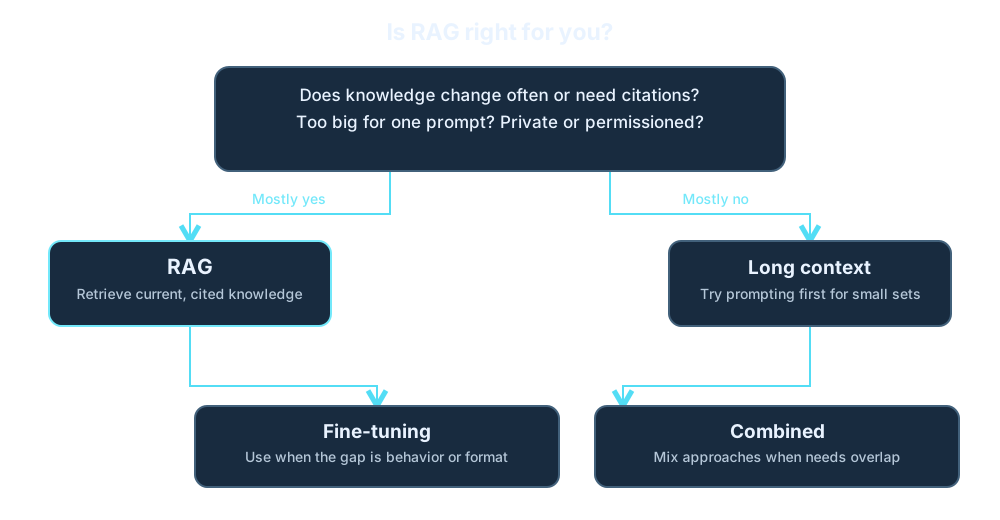
Does your knowledge change often? Must answers cite sources? Is the source set too large for one prompt? Are access rules private or permissioned? If mostly no, start by considering prompting or long context. If the gap is behavior rather than knowledge, consider fine-tuning.
A combined approach can be justified when retrieval, whole-document reasoning and consistent output behavior are all needed.
Pilot planning
Pilot planning sequence
Typical path; depends on scope. These are stages, not promised dates.
1. Choose
Select one bounded use case and collect real questions.
2. Inventory
Map sources, owners and permissions.
3. Prototype
Build citations and a baseline evaluation.
4. Pilot
Test with a small group, measure outcomes, then decide whether to expand.
Planning inputs
What we need from you
- A business owner
- A bounded use case
- A representative evaluation set drawn from real questions; an initial pilot may use dozens (often 50–100 where appropriate), then expand for risk, departments and production feedback
- Access to relevant sources
- A security or IT contact
- A definition of a wrong answer and its cost
Decisions we make together
Data boundary
Select cloud, private cloud or on-premise boundaries based on actual constraints.
Model choice
Compare inference options against quality, latency, governance and cost.
Permission model
Agree identity and access checks before retrieval reaches the prompt.
Success measures
Define representative questions, evaluation criteria and thresholds together.
Reference stacks and pgvector
Reference stacks
Examples for architecture discussion, not fixed products.
Starter
Existing PostgreSQL with pgvector where workload, filtering and operations fit; a hosted or self-hosted embedding model; one LLM endpoint.
Private
A self-hosted vector database such as Qdrant or Milvus, self-hosted embedding and reranking servers, an open-weight model behind an OpenAI-compatible endpoint, and ingestion inside your boundary.
Scaled
A clustered vector database; separate ingestion, embedding, retrieval and generation services linked by a queue; autoscaled workers and monitoring dashboards.
Pin model weights and containers and store them in your own registry for reproducible, controlled deployments. PostgreSQL with pgvector or a dedicated vector-search platform should be selected against latency, scale, filtering, availability, update frequency, operations and cost—not corpus size alone.
Production operations and freshness
Production operations
Production RAG needs an operating loop, not just an initial index.
Freshness
Hash content to detect changes; re-index changed chunks, propagate deletions and revoked access, and keep version and indexed-at metadata.
Embedding and chunking changes
Re-embed after changing model or chunking strategy; run old and new indexes side by side until evaluation supports cutover.
Observability
Trace ingestion, retrieval, reranking and generation; watch latency, errors, indexing success and freshness, and sample answers for quality alerts.
Reliability
Use safe caching, timeouts, suitable fallbacks such as skipping a slow reranker, and backups of both index and metadata.
Live data
Query current counts, statuses and owners from source systems rather than embedding snapshots.
Security and compliance alignment
Security and compliance alignment
Integrate SSO and role- or attribute-based access; decide encryption in transit and at rest, audit logs, residency and retention with your team. Controls depend on your environment and applicable obligations.
Engagement diagram
Engagement model
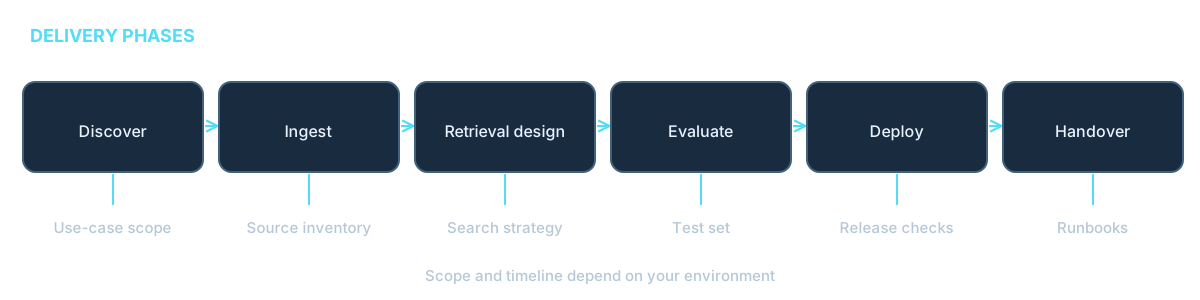
- Discover — scoped use case
- Ingest — source inventory
- Retrieval design — architecture specification
- Evaluate — test results
- Deploy — operational system
- Handover — documentation and playbook
Scope and timeline depend on your data, systems and security requirements.
How we work
How we work
Evidence first
A fixed-scope assessment or proof of concept helps you decide using your own questions.
Phased delivery
Production work advances through explicit architecture, evaluation and deployment decisions.
Team ownership
Your team receives documentation and training to operate the result.
Optional operations
Monitoring and tuning can continue as a separate engagement.
Design patterns
Design patterns
These are design patterns, not customer case studies.
Internal policy assistant
Find approved policy passages with citations and access checks.
IT / support knowledge base
Surface relevant instructions from maintained support documents.
Technical documentation search
Locate version-specific guidance and its original source.
Compliance and contract Q&A
Retrieve controlled clauses for human review, not automated legal advice.
Illustrative cited answer
Question: Which policy governs document access?
Answer: Consult the current access policy [1] and the applicable document classification guide [2]. Confirm the policy version and your access rights before acting.
[1] Example: access policy (illustrative source)
[2] Example: classification guide (illustrative source)
Technology options
Technologies
These are examples for architecture discussion, not partnerships or endorsements. Selection depends on your environment.
Connectors
- Document repositories
- Internal APIs
Embedding and reranking models
- Domain-aware embeddings
- Cross-encoders
Vector and keyword indexes
- Vector search
- Keyword search
Open-weight and hosted LLMs
- Self-hosted inference
- Hosted inference
Evaluation and observability
- Test sets
- Tracing
Frequently asked questions
Does RAG eliminate hallucinations?
No. Source quality, permissions, evaluation and citation checks still matter; retrieved material can be incomplete or misleading.
How are access and data boundaries defined?
We map identity, document permissions, tenant boundaries and hosting requirements with you. Current permissions filter results before building the model prompt.
When is RAG not the right choice?
For a small, stable document set, prompting or long context may be simpler. Structured live data can be better queried directly.
Cloud or local?
Either can work. Data sensitivity, infrastructure, latency, operating effort and residency needs shape the choice.
How do you keep answers current?
Detect source changes, re-index changed content, propagate deletions and revoked access, and monitor index freshness.
How do you measure answer quality?
Build a set of real questions and separately evaluate context precision, context recall, faithfulness and answer relevancy against agreed targets.
What do you need from us to start?
A business owner, bounded use case, representative questions, source access, a security or IT contact, and the cost of a wrong answer.
What is the first step?
Choose a bounded use case, then discuss its source material, permissions and success criteria.
Can RAG respect document permissions?
Yes, when identity, source permissions and document-level entitlements are mapped and enforced during retrieval before approved context reaches the model. Connector behavior depends on the source and architecture.
Can RAG connect to SharePoint, ServiceNow or Salesforce?
Potentially. Connector availability, licensing, API access, source permissions and data handling must be assessed for each system; a named platform is not a promise of a ready-made integration.
Can RAG run in our private cloud?
Depending on the required components and integrations, retrieval, storage, orchestration and models can be deployed in a customer-controlled cloud or private environment. Features and operational responsibilities vary.
Do we need a vector database?
Not always. Some bounded use cases may use search or long context without one. Storage should follow retrieval, filtering, update, availability and operating requirements.
Can PostgreSQL with pgvector be used?
Yes, when the workload fits the required filtering, indexing, latency, throughput, availability and operational model. Corpus size alone is not a sufficient selection rule.
What is hybrid search?
Hybrid search combines semantic vector retrieval with lexical methods such as BM25. It can help with both conceptual language and exact technical identifiers; its value should be measured on representative questions.
What does reranking add?
A reranker can reassess candidate passages before generation to improve relevance. It adds compute and latency, so evaluate the trade-off and retain authorization controls.
How do you protect against prompt injection?
Treat user input and retrieved documents as untrusted. Combine source trust, context separation, least-privilege tools, output checks and human approval for sensitive actions; no single control eliminates the risk.
What happens when a source document is deleted?
A production ingestion process should detect removal and delete or revoke retrievable access to affected content; verify propagation and monitor for stale indexed copies.
Can RAG cite its sources?
It can return document identifiers or passage references when ingestion preserves provenance and the retrieval and answer design support citations. Citations still require validation.
Can we use local or self-hosted models?
Where workload, infrastructure, licensing, security and model capability fit, self-hosted components are an option. Compare them with managed services on quality, operations, availability, latency and cost.
How long does an implementation take?
It depends on source quality, permissions, integration, evaluation, security review and organizational readiness. Agree on pilot scope and success criteria before committing to a timeline.
Ready to Turn Enterprise Knowledge Into Trusted AI Answers?
TBW can help assess, design, secure, build, test and operate permission-aware RAG systems.